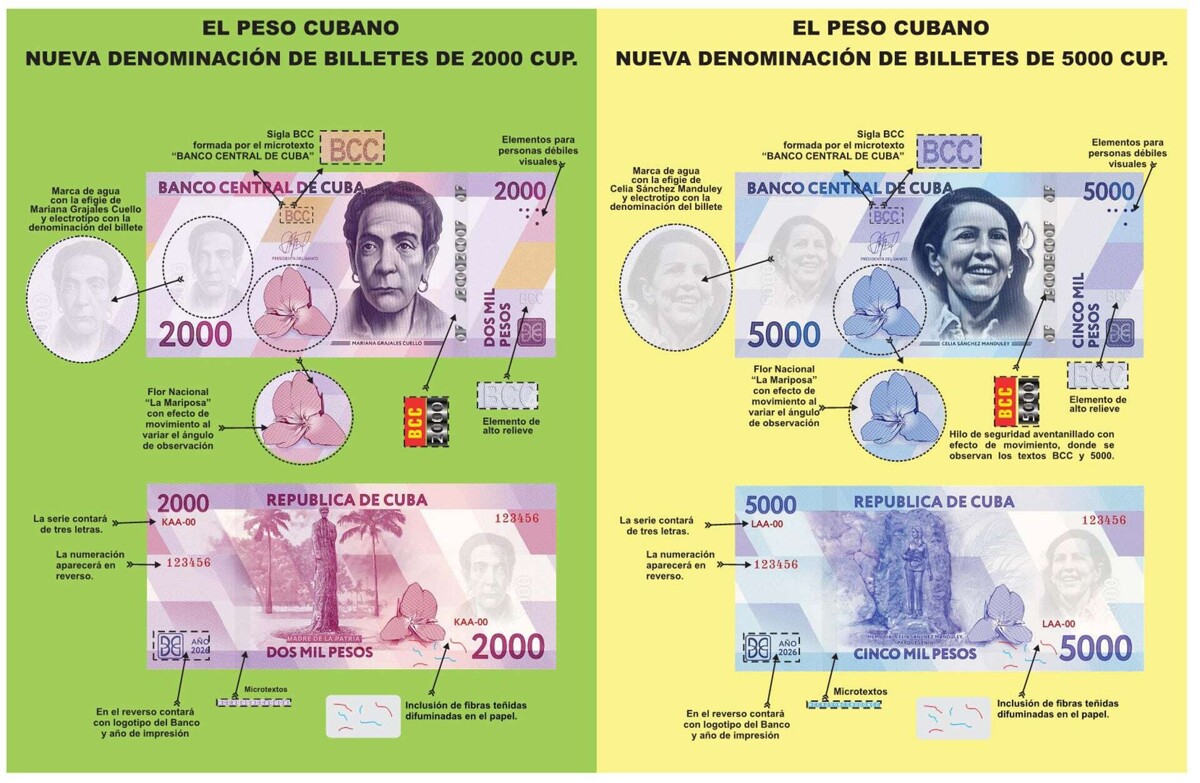
The combination of the COVID-19 pandemic, the tightening of U.S. sanctions, and failed national economic and monetary policies have aggravated the structural problems of the Cuban economy. This situation has deteriorated notably since January due to Washington's decision to block any fuel shipments to the island. The Cuban economy in 2026 is characterized by a severe and deep crisis, marked by the collapse of the energy infrastructure, a critical shortage of fuel, food, and medicine, and high inflation. The Central Bank of Cuba (BCC) announced this Tuesday that two new banknotes of 2,000 and 5,000 Cuban pesos (CUP)—the official currency—will be gradually put into circulation starting April 1st to deal with rising prices due to high inflation and a cash shortage. The issuance of the new high-denomination banknotes responds to the demand for large amounts of cash and aims to reduce costs from cash logistics and gain operational agility in this moment of an inflationary spiral in the country, a BCC communiqué published in official media noted. The 5,000-peso banknotes will circulate first in Havana and will progressively be introduced throughout the country, and then the 2,000-peso notes will be issued, the institution specified. Currently, banknotes of five, ten, twenty, fifty, one hundred, 200, 500, and 1,000 pesos are in circulation. What historical figures will appear on the new banknotes in Cuba? These new denominations, for the first time in the Cuban currency, include images of female figures: the patriot Mariana Grajales, mother of Antonio Maceo, one of the leaders of the 19th-century independence wars, and Celia Sánchez, a guerrilla fighter of the Sierra Maestra who, after the triumph of the revolution in 1959, held important government positions. Their introduction takes place in a scenario of high inflation and devaluation on the informal market, where the purchasing power of the Cuban peso (CUP) has lost its value drastically. The annual inflation rate in the formal market in Cuba stood at 12.33 percent in February, a slight drop from January (12.52%), according to the National Office of Statistics and Information (ONEI). The devaluation of the Cuban peso against the dollar In recent days, the CUP hit a historic low on the informal market, depreciating to 515 units per U.S. dollar, in the context of increasing U.S. pressure on Cuba. The devaluation of the Cuban peso on the informal market has been occurring since the failed monetary reform of 2021, called 'Tarea Ordenamiento,' which sought to end the dual currency in the country (previously, there was also a convertible peso at par with the U.S. dollar). Since late 2025, the BCC has implemented a third official exchange rate, of a floating nature and updated daily, which started at 410 Cuban pesos per dollar for exporters and economic actors, seeking to reduce the gap with the informal market. This measure coexists with the previous rates of 24 and 120 CUP per dollar. That exchange rate has been climbing and on this date stands at 480 units of the national currency per dollar. The economic crisis in Cuba Cuba has been mired in a serious economic crisis for more than six years.