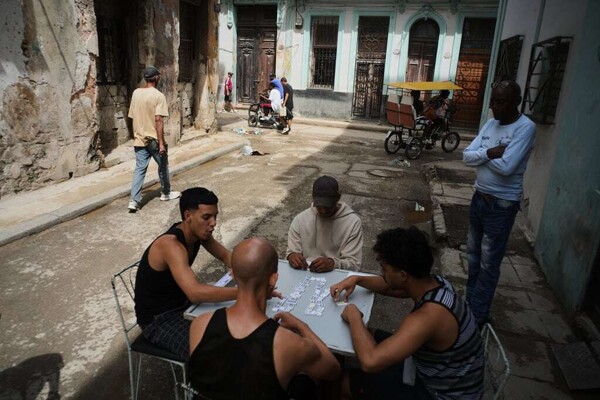
Cuba's tourism sector, vital to its economy, was already in crisis before the energy situation worsened in January due to Washington's oil siege. According to the National Statistics and Information Office (ONEI), only 77,663 tourists arrived in the country in February. The number of travelers from the two largest source markets, Canada and Russia, fell by 28.4% and 7.6% respectively, to 124,283 and 20,668 that month. Most markets recorded declines during this period, some markedly, such as the Cuban community abroad, which fell by over 40% to 23,002 travelers, and the United States, which dropped by 55.9% to 11,791. Figures also fell for Mexico (6,674), France (5,649), Spain (4,422), and Italy (4,059). 'Everything in Cuba is at a standstill,' Alberto Ruiz Laffitte, who cares for classic convertibles for tourists, told EFE. Blackouts are constant, it's hard to get fuel for cars, and the streets appear dark and empty—a scene reminiscent of the COVID-19 pandemic. As of February, 262,496 international visitors had arrived, 112,642 fewer than in the same period the previous year, reported the Caribbean nation's ONEI. The tourism sector, essential for its economy, was already in crisis before the energy situation worsened in January due to Washington's oil siege. In 2025 alone, the country received 1,810,663 international visitors, the worst figures since 2002, excluding pandemic years. 'There is very little tourism. We will not abandon the Cubans,' Energy Minister Sergei Tsiviliov declared to local press at an energy forum in Kazan. The minister noted the decision was made after a meeting in St. Petersburg with Cuban representatives. The US and EU-sanctioned oil tanker 'Anatoli Kolodkin', carrying 100,000 tons of crude, arrived in Cuba this week, marking the first oil shipment to the island in three months, following the blockade imposed by the US after the capture of Nicolás Maduro in Venezuela in January. 'This valuable aid arrives amidst the energy siege imposed by the United States, which seeks to suffocate the Cuban people,' Havana's Foreign Ministry posted on social media X. Trump downplays crude arrival to Cuba. US President Donald Trump downplayed that Moscow broke the Washington-imposed blockade and dismissed that the arrival of oil would have any impact on the island's current situation. 'It doesn't bother me (...) they have a bad regime, they have bad and corrupt leadership, and whether an oil ship arrives or not, that doesn't matter,' the president indicated. The inability of Cuban authorities to meet energy demand led to a critical point of oil shortage, worsening daily blackouts and causing near-total economic paralysis, as well as affecting basic health, transport, and other services. Hotels closed, streets empty: Collapse of tourism in Cuba. The streets of Old Havana are almost without tourists, even during Holy Week, showing an image of neglect in Cuba. Russia is preparing a second oil shipment to Cuba after the first one broke the three-month US energy blockade on the island, Energy Minister Sergei Tsiviliov reported this Thursday. 'A Russian ship broke the blockade. Amid the energy crisis, the island is experiencing a tourism collapse, with 30% fewer visitors in the first two months of the year compared to 2025. 'In this area: Old Havana, Central Park, the mythical Capitolio, tourism is bad because of the energy problem. Tourism is not coming because of that (...). Only visitors from Argentina (10,590) and China (5,429) increased. Now the second one is being loaded. There is practically none.'

Cuba's Energy Crisis and Tourism Collapse
Cuba's vital tourism sector is in deep crisis due to an energy collapse. Blackouts, fuel shortages, and economic paralysis have caused a sharp drop in foreign tourists, while Russia sends oil to the island bypassing US sanctions.