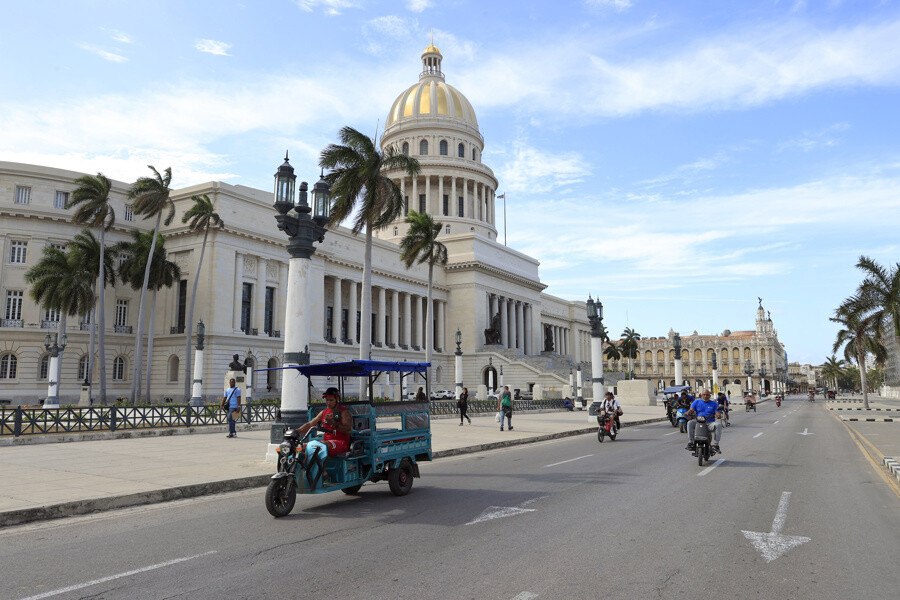
Cuba is facing a severe energy crisis, leading to a transportation collapse in its capital, Havana. Main avenues, once filled with tourists, are now nearly empty. Restaurants and hotels are closed due to a lack of customers, and most gas stations have not sold fuel for over two months. As an alternative to gasoline vehicles, various and creative electric vehicles have emerged in the city, particularly cargo tricycles adapted for passenger transport. Liset de la Caridad, a Havana resident, told EFE that because she lives far from the city center, she pays nearly 1,000 pesos (two dollars) daily for transportation. The minimum monthly wage in Cuba until mid-2025 was set at 2,100 CUP (17.5 dollars), with the average at 6,506 pesos (54.2 dollars). Minimum pensions are 3,056 pesos (25.4 dollars). "These tricycles solve the transportation problem quite well," explains Alfonso, who works about twelve hours a day on a route from Parque de la Fraternidad to the Toyo area, a nearly ten-kilometer round trip. Like Yamiselis and Alberto, dozens of these tricycle drivers can be seen on every avenue in the capital. This profession has also become a job for young women in Havana. Yamiselis Alfonso, another driver, told EFE that "she has been driving on a fixed route for six months." Her tricycle can carry six seated passengers. At the beginning of February, Cuban President Miguel Díaz-Canel stated that his government was preparing for a plan of "acute fuel shortage" due to U.S. pressure. As a result, intercity bus services were reduced to a quarter of their usual frequency, and local transport and other services deemed "low priority" by the government were almost entirely canceled. Minister of Transportation Eduardo Rodríguez announced on March 18 that even patients undergoing hemodialysis have been offered transfer options by taxi or electric tricycle. Díaz-Canel had previously stated at a press conference on March 13 that not a "single drop of fuel" had reached Cuba since January. About 15 days later, the Russian oil tanker Anatoli Kolodkin arrived in the country with 100,000 tons of crude oil, which will be converted into 250,000 barrels of diesel in the coming weeks—enough to cover the country's demand for a little over 12 days. Additionally, in recent weeks, thanks to measures taken in Cuba and the U.S., some imported fuel has begun to flow to the island's nascent private sector, around 30,000 barrels so far this year. "These are just crumbs," commented Cuban economist Omar Everleny.